
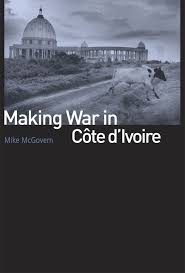
Making War in Cote d’Ivoire. Mike McGovern
Nauczyciel antropologii na Uniwersytecie Yale przedstawia nam wnikliwą analizę iworyjskiego konfliktu z lat 2002-2007, który na całe szczęście nie przerodził się w otwartą, brutalną i pełną straszliwych masakr wojnę jaką widzieliśmy w sąsiedniej Liberii czy Sierra Leone. Historia ostatnich kilkudziesięciu lat jednego z najbogatszych krajów Afryki Zachodniej zawsze połączona była z uprawą kakao, walką o władzę prezydencką oraz podziałami etnicznymi, którymi to pretendenci do tronu umiejętnie sterowali załatwiając swoje interesy. Autor analizuje przyczyny, które miały wpływ na to, że jeden z zasobniejszych krajów tego regionu, rządzony niepodzielnie przez długie lata przez Félixa Houphouët-Boigny’ego popadł niemalże w ruinę i dzisiaj to co “działało” jeszcze kilkadziesiąt lat temu dziś “nie funkcjonuje”, a kraj ekonomicznie się cofa. Przejdziemy od dawnej historii ziem Afryki Zachodniej, przez kolonizację, w której częściowo można doszukiwać się źródeł dzisiejszej przemocy, przez lata prosperity, aż do teraźniejszych czasów bezpardonowej walki o fotel prezydencki. Książka wydana była w roku 2011, więc autor nie zdążył napisać o tym, że dzisiaj Laurent Gbagbo, główny (pewnie nie jedyny) winowajca kłopotów i zamieszek w kraju, siedzi już w europejskim więzieniu, a jego konkurent Alassane Outtara szykuje się do rządzenia przez kolejną kadencję. Cytaty:
“Baule are closely related to the Asante of present-day Ghana, who did have a large centralised state in the pre-colonial period”.
“During the colonial period, French colonial governments imposed a cash tax on all adults”.
“The Lebanese community numbered about 170 000 before the anti-foreigner violence of Nov. 2004, according to one leader of the Lebenese community”.
“The fact that most countries in West Africa include both forest and savanna zones is mostly an artefact of European colonial conquest”.
“As the Dan say, ‘It is not what you do that matters, but that you do it better than any other. Be the best blacksmith, or drummer, or carver, or dancer of a certain type of mask, or seducer of women, or even thief'”.
“Resentment by Ivorians from the north at being second-class citizens in their own country. This is the one and only source of legitimacy belonging to the Forces Nouvelles”.
“Prince Johnson, a one-time Taylor colleague who filmed himself overseeing the torture and murder of Liberia’s President Samuel Doe in 1990, also became ‘born again’, and returned to Liberia in 2005 to be elected to the Liberian Senate”.
“Women in Niger, for instance, give birth 7,1 times on avarage – the highest birth rate in the world. Ivorian women give birth to 4,6 children on avarage, down from 7,4 in the period 1970-75”.
“Violence wasn’t born of Africa’s (colonial) domination, but it was amplified”.
“The Ivorians think of themselves as very superior to us Guineans. But they will see. We cut our ties with the French 30 years ago, and we paid a high price for it. The Ivorians are still rich, but their wealth is ephemeral. They are benefiting a little while the Frencj continue to suck them dry”.
“…That assertion is highly debatable, as Guinea followed a different, but perhaps even more devastating path to ruin”.
“The Ivorian style of ‘looting’ is also more sophisticated than the Liberian one”.