
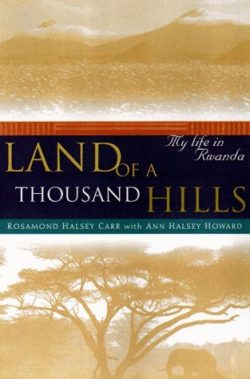
Land of a thousand hills. Rosamond Halsey Carr with Ann Howard Halsey.
To historia życia Amerykanki Rosamond Carr w Rwandzie. Losy i perypetie autorki ukazane są na tle historii tego małego, ale jakże pięknego i ciekawego kraju położonego w samym środku Afryki. Książka jest tak napisana, że faktycznie wciąga i szybko przewracane kartki sprawiają przyjemność. Pani Carr najpierw przyjechała do Rwandy z mężem zarządzać farmą, na której uprawiali złocienie, a pod koniec życia, kiedy wróciła po ludobójstwie w 1994 roku, otworzyła na farmie w Mugongo sierociniec dla rwandyjskich dzieci. Nietuzinkowe życie w kraju tysiąca wzgórz. Cytaty:
As a rule, foreigners were perceived differently in Ruanda than in most African countries. Never in Ruanda have the Europeans (‘wazungu’) or Asians been expelled or even harassed. At the time if Ruanda independence, leaflets were dropped from airplanes that read in Kinyaruanda, the local Bantu language, ‘Europeans and Asians will show us the way to economic prosperity.'”
The Tutsi were the tribe of the feudal kings of Ruanda and represented a relatively small percentage of the population. They were the aristocratic minority who ruled Ruanda in a tenuous partnership with the Belgian administration. As a rule, only the Tutsi held positions in government, education, and the priesthood. Tall and slender, with small heads, slightly tilted eyes, aquiline noses, and delicate lips, they towered abouve the rest of their countrymen in both stature and rank.”
The Hutu made up the vast majority of Ruanda’s population and were predominantly agriculturists. It was the Hutu farmers who cleared the land, planted the fields, and harvested the crops to sustain Ruanda’s agrarian economy. Short and thickest with irregular features, they were cheerful, hardworking peasants with high moral standards and an endearing propensity and melodramatics.”
“By the 1950s there remained only several thousand pygmies in Ruanda. The Batwa had no tribal organization to speak of, and their lives were devoted largely to hunting. They lived a primitive existence in the mountainous regions, far removed from their longtime oppressors – the Hutu and Tutsi.”
“Pygmies were not required to pay taxes in those days, and indeed it would have been difficult to extract payment from these peculiar little people who had no money and no intention of earning any.”
“Prior to 1960, public elementary schools in Ruanda were almost exclusively for Tutsi children.”
“Ruanda has a long history of colonial domination. The first colonizers were the Hutu, who overpowered the Batwa meny hundreds years ago. The second wave of colonization began sometime during the fiftieth century when the Tutsi migrated to the region and overpowered the Hutu. The third wave of colonizers were the Europeans, who arrived at the end of the nineteenth century.”
“Ruanda’s Tutsi leader had sealed their fate by openly denouncing the Belgian administration.As a result, the Belgians reversed their allegiance in support of the Hutu. Many of the Tutsi chiefs fled the country, and those who did not were either in hiding or in prison”